
Dealing with Winter and Cold Weather on the farm
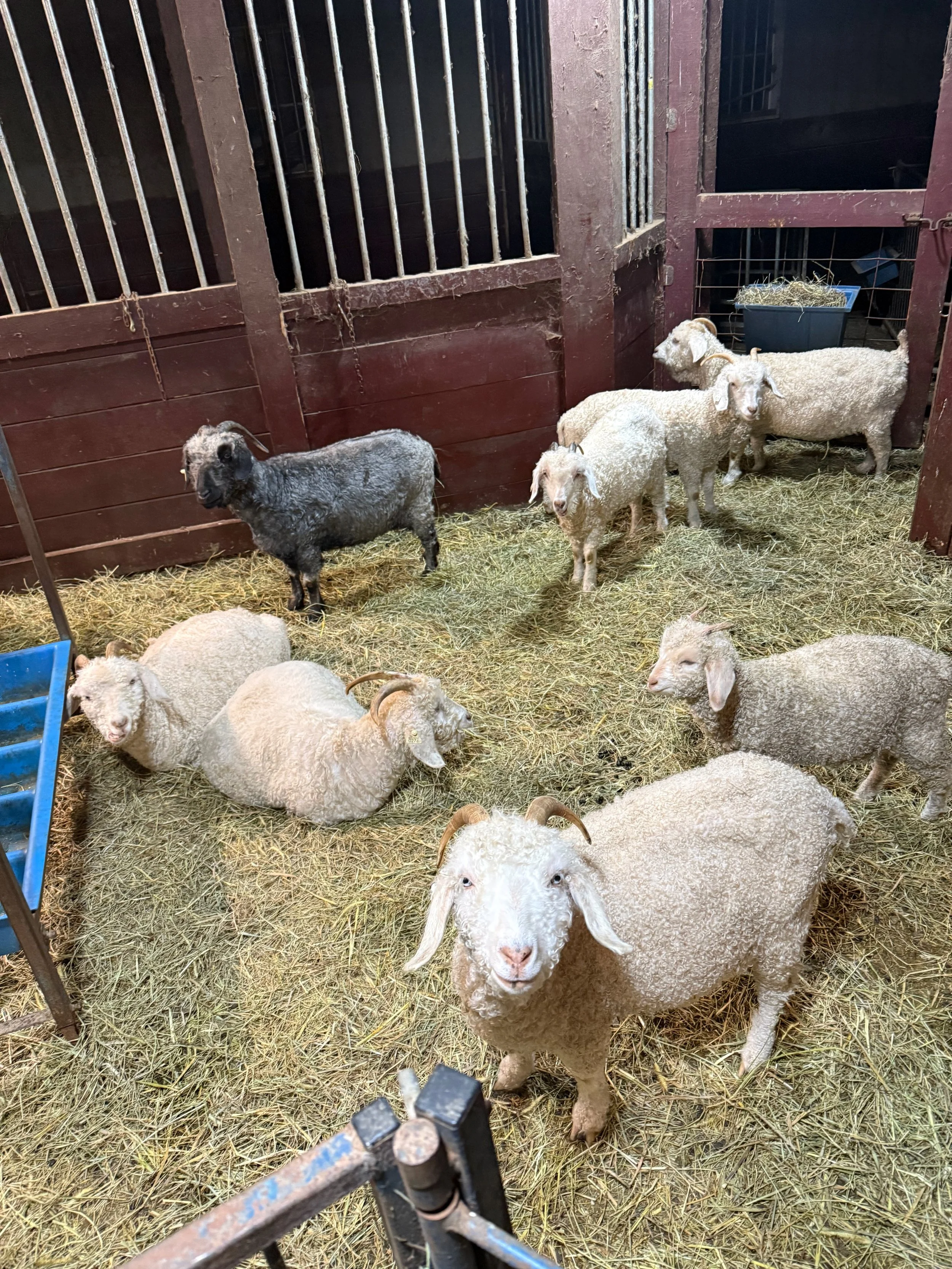
Angora goats inside the barn
Every season brings its joys and challenges and winter is no exception. As I write this it is mid-December, so technically not yet winter from a calendar standpoint. However, as all local readers know, it is certainly meteorological winter and we have been having cold days (and now snow) for a few weeks now.
So what are the “joys” (i.e. the benefits) of winter - from an animal management standpoint? First and foremost, the parasite problem virtually disappears. Parasite eggs and larvae are not cold hardy and freezing temperatures often kill them. Some can survive dormant under snow or in milder weather, but infestation is greatly (if not totally) reduced. The colder the temperature, the more parasites that will be killed; so colder temperatures are actually better for parasite control. Secondly, colder temperatures can lead to the wool for the Merino sheep and the mohair for the Angora goats to have characteristics that feels finer than fiber grown in warmer months.
Maryland winters are not a problem for the Merino sheep. In cold conditions, their wool becomes denser, trapping air close to the body for warmth. The documentation on Merino sheep notes that their incredible fleece will keep them warm in temperatures down to about 0 degrees (Fahrenheit). Additionally, Merino wool contains lanolin, a natural fat content that coats the fibers. This creates a water-repellent layer that prevents moisture from reaching the skin, keeping the sheep dry and warm in wet or snowy conditions. I have seen the Merino sheep outside on the pasture when it is in the single digits (and the wind is blowing), without suffering any ill affects - and declining to come inside because they would rather stay on the pasture. For safety, every night they do go under a shelter that is protected from the wind and I make sure they receive buckets with warm water to drink and high-quality hay to eat.
As compared to the Merino sheep, the Angora goats are more vulnerable to the cold winter temperatures. Their fiber is locky and not as dense as the wool on the Merino sheep and the goats do not have lanolin in their fiber; this allows easier penetration of air and more rapid wetting of the skin during rain or snow. Also, Angora goats generally have a smaller body mass and a larger surface area relative to their size, which facilitates faster cooling. Finally, I shear the Angora goats in May and November and once shorn in November, they need a number of weeks to regrow fiber dense enough to withstand cold temperatures. So to ensure good health, once shorn the goats stay in a heated barn at night for at least 6 weeks. And even after that, my rule of thumb is to ensure that have heat if the temperature will drop below 20 degrees.
During the day in the winter, I let the goats out to graze around 10 AM, once the sun is up, and put them up around 4. If the day is particularly cold (and/or windy), they will go up earlier. And they let me know if they want to go in. If very cold, they will line up at the entrance to the barn (or at the gate for the field they are in), which is their sign that it is time to come in. Last year, during the days we had the polar vertex, when the high for the day a few times only got to the low 20s, I let them out at 11 AM and by 2 PM they would be at the gate to want to come back inside the heated barn. They also get warm water to drink when cold. And both the goats and sheep get some grain and alfalfa pellets at night for nuitrition.
When it snows, my rule is neither the sheep or goats are allowed outside to graze. The sheep will go out and paw the ground to get down to the grass, but it is not optimum for their health. The goats will simply refuse to go outside if there is any appreciable accumulation of snow. (If there is a very light coating of snow and it is not too cold, I will let the sheep and the goats outside to graze.)
The Peafowl and the Blue Cochin chickens handle the cold well. Peafowl (Indian Blues especially-which is what I have) are surprisingly cold-hardy, tolerating temperatures well below freezing - as long as they have a draft-free shelter, access to unfrozen (warm) water, and dry, elevated roosts to keep their feet off the cold ground. The Blue Cochin chickens also handle cold well due to their heavy, fluffy feathering, which provides excellent insulation. They need to keep their feathered feet dry to prevent frostbite and access to a draft-free, well-ventilated coop. If you have seen the peafowl and chickens on a visit, you know they do have all that they need. They also get extra high-energy food as the cold weather burns up more calories. I do not use heat lamps for the birds; they can be a fire hazard and cause huge temperature swings between the coop and outside, which can stress them.
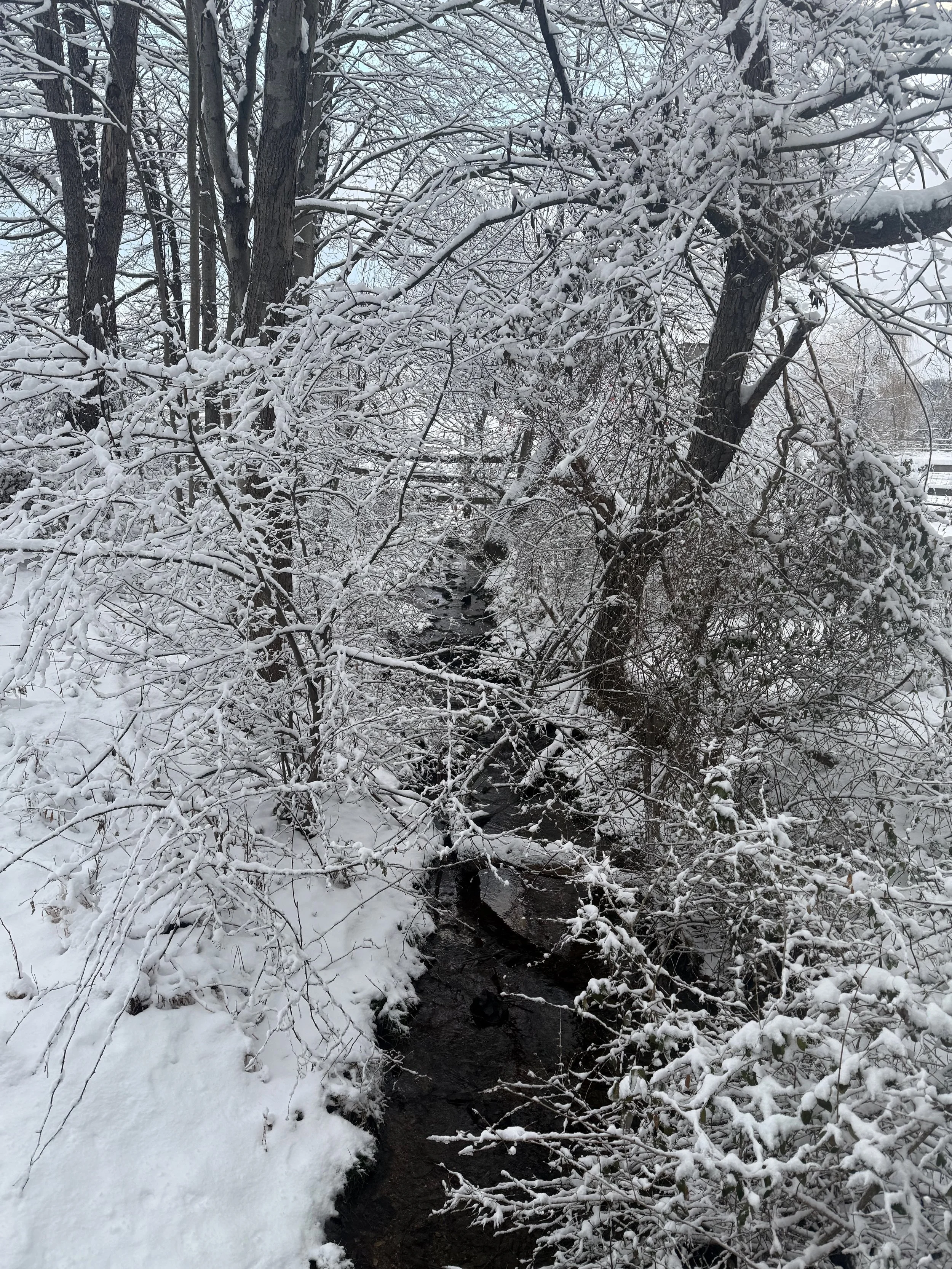
Creek and woods after snowfall on 14 December
I put out food for the wild birds year round and during the cold months, especially when snow is on the ground, I put out extra food for them. My favorite birds to watch are the Blue Jays; I put peanuts out for them and they quickly fly over to pick them up and fly off to enjoy a snack.
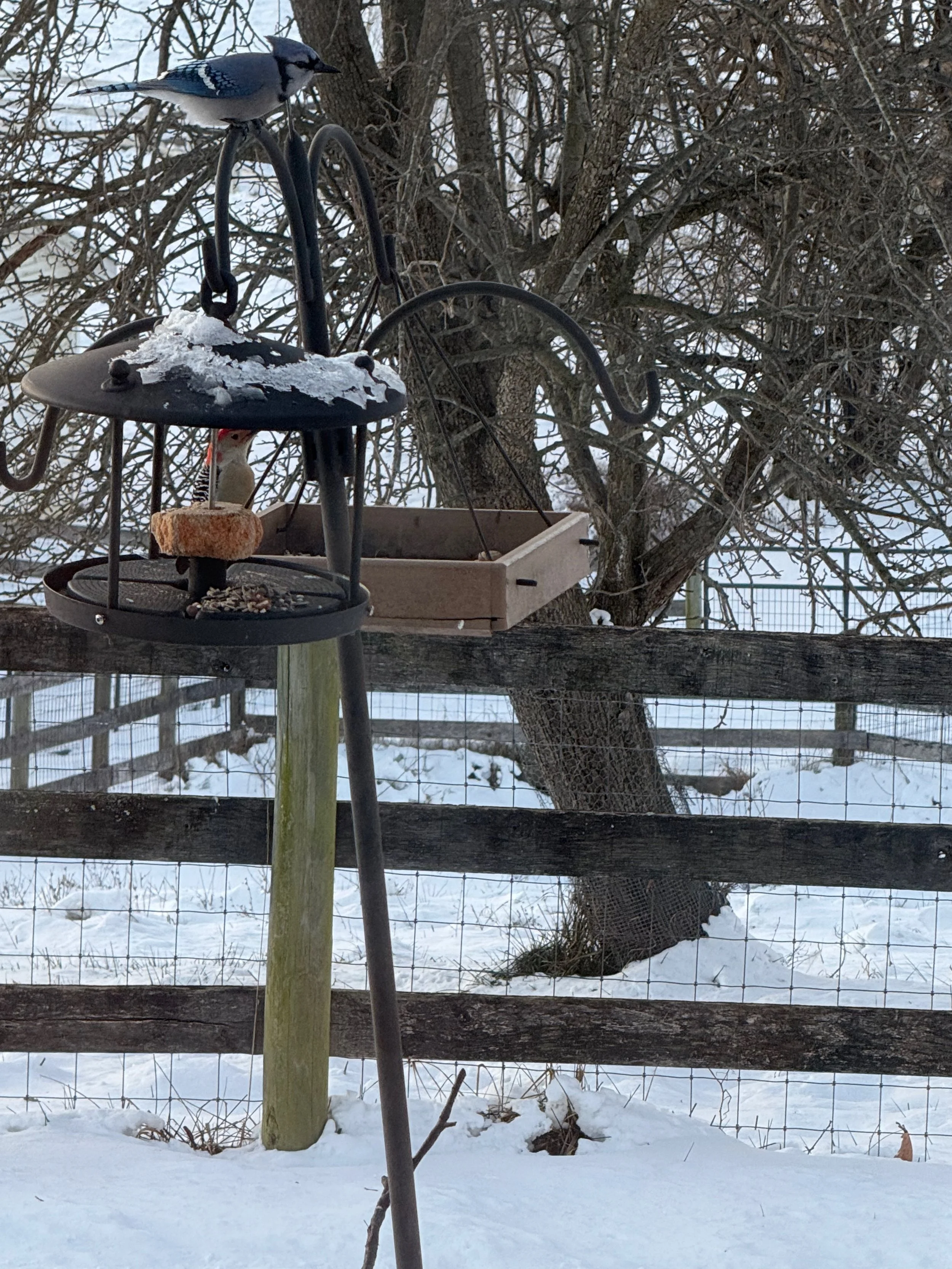
Red Bellied Woodpecker and Blue Jay
I wish everyone a merry Christmas and happy holiday season. The shop will be closed on 24 and 25 December but otherwise open as normal.