
July 2026 Happenings at Withers Wool and Farm
Farm and Animals
July is historically the hottest month in Maryland and this July has been no exception. We (and lots of the country) have had two heat waves. Fortunately the temperature on the farm is usually about 5 degrees cooler than the temperature in Frederick or Baltimore but we still got up to the the low to mid 90s and a heat index over a hundred for a few days. All the animals were fine thanks to staying in the shade, lots of air from fans, and getting cool water to drink.
The rain has been a bit erratic but plentiful enough that the fields are in good shape and grazing is plentiful on the various pastures. My one headache with (some of) the pastures has been with a weed called the Carolina horsenettle. It is covered in star-shaped hairs and sharp yellow prickles and is toxic to animals (and humans). The goats do not eat it but its leaves can get stuck to the fiber on the kid Angora goats since their fleece is so fine. (It generally does not stick to the adult Angora goats.) Since I do not use pesticides or herbicides, the only way for me to get rid of it is to pull it up by hand. Now I only do this on the small fields around the white barn that the kid goats and their moms are on but this is still quite a chore. I know I have missed pulling up some of the horsenettle if the kid goats come in for dinner in the evening and they have the leaves on their fleece - and I then need to pull them off.
Willow and Ash, the kid Angora goats, are doing well and continuing to thrive. I think they are the fastest growing Angora goat babies I have ever had. They were born early April so are now over three and a half months old. And both are still occasionally nursing.
Normally the peacock (the male peafowl) drops off his long tail feathers in August; these are the feathers that he grows in January and uses to court the peahens. (And which I pick up and put in the vases in the shop.) However, they have been dropping off this year in July and as I write this he only has one or two (of the long feathers) left on his body. I did a little research and found out that once breeding activity slows down, hormone shifts cause the feathers to drop. The peacock has greatly reduced his courting activities in July so I guess that is it and he started molting earlier than in past years. (As a reminder, visitors to Withers Wool and Farm are welcome to take home a peacock feather when they visit.)
Does anyone else think there are a lot of deer around this year? I have seen more deer and had more on the property in July than any other time I can remember. I do not want deer grazing in the pasture as there is a complicated cycle in which they can introduce a parasite called the meningeal worm to the pasture. Fortunately the goats rarely get infected (this issue is much more prevalent with alpacas and llamas) but if they do, you have to take immediate action to prevent major issues. So when I see a deer grazing, I always move towards the deer so it bounds away out of the pasture it is in.
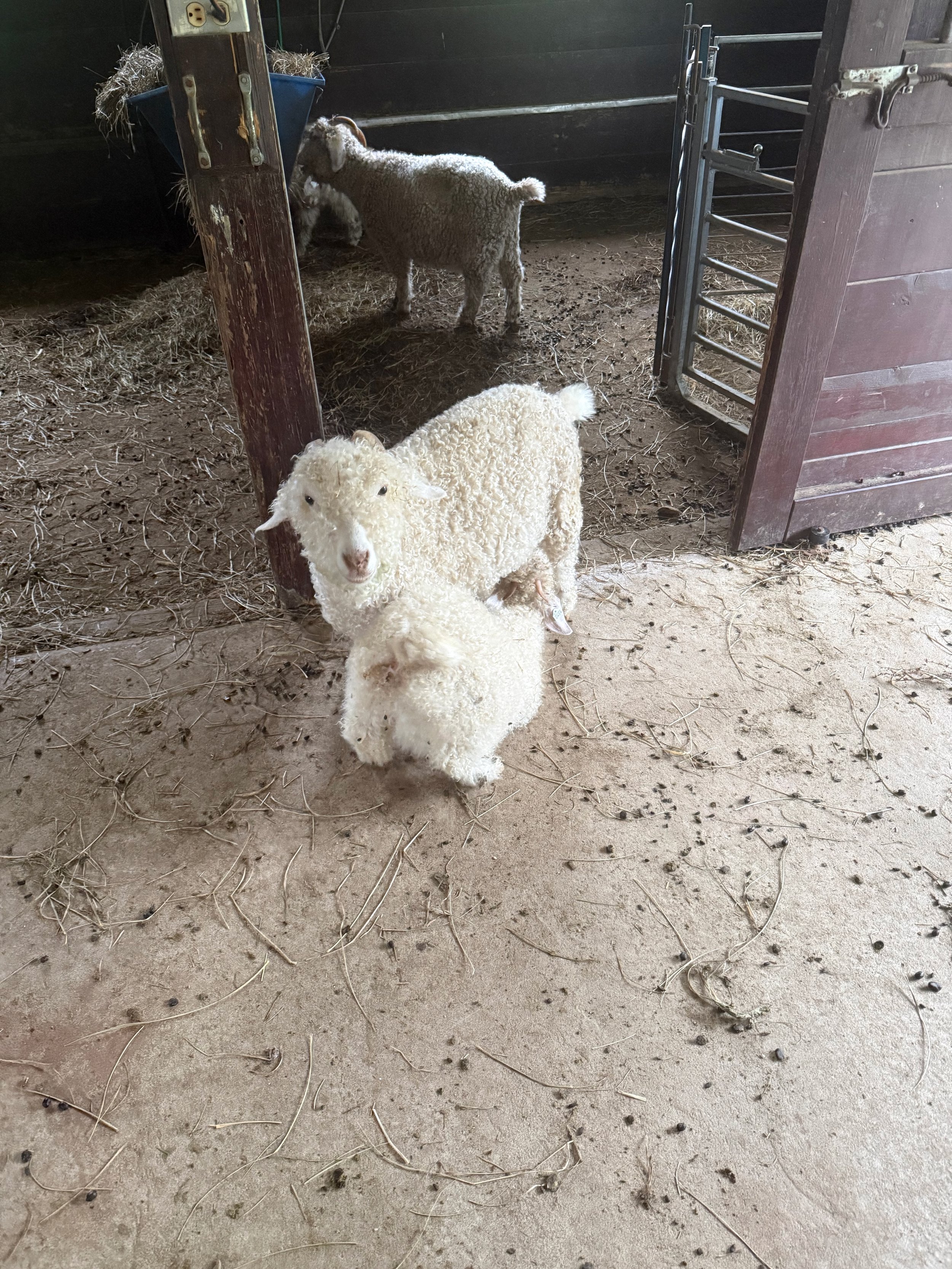
Willow nursing from her mom, Plum
Fiber and Shop
I am still slowly working my way through processing Cutie Pie’s fleece (my star Angora goat). If you remember, she was sheared in May, then her fleece was initially skirted and tumbled followed by washing and full skirting of her fleece in June. Then this month I used the Patrick Green picker on her fleece followed by carding the picked fleece. All of these activities were posted on social media. Next is the final step to spin the part of her fleece that was picked and carded, which I will do in early August.
I have continued to do a lot of dying (of yarns) this month. My main thrust has been to take some 2-ply marled yarn I have and dye them. (Marled yarn is made by twisting two - or more - diferently colored individual strands together.) In this case I have been using a marled yarn composed of a white strand and a tan strand and then dying it. The effect is then a two toned yarn of the different dye colors I have selected.
I made a trip to Lancaster Creek Spinnery to drop off some more fiber and pick up some new mill spun yarn: two different colors (cream and light wood) of bulky yarn (first sets of bulky mill spun yarn for Withers Wool and Farm) and some fawn colored worsted yarn. And I received one bag of roving - the fawn colored roving that was also used to make the worsted yarn.
Handspinning continues on. This month I have finished and put in the shop an elastic yarn, 3 stand-alone singles, a spiral ply with coils, a yarn with cogs (i.e. little wheels), a beaded yarn, a thick and thin and a number of 2 ply and cable yarns. I am also, very slowly, continuing to thoroughly inventory all the handspun yarns.
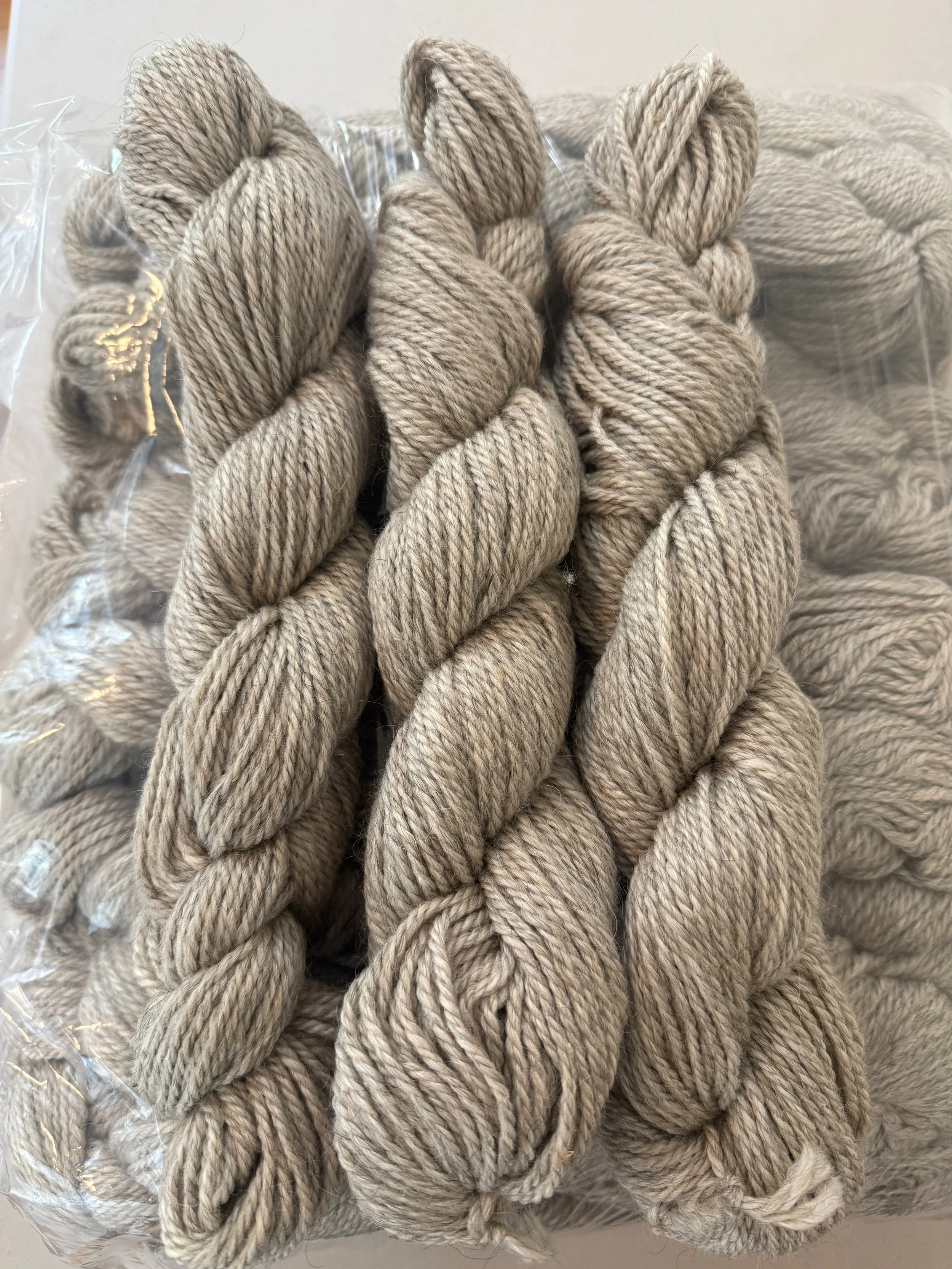
Light wood colored bulky yarn
Events
We have had a number of classes at Withers Wool and Farm in July: two beginning spinning classes; one beginning knitting class, one nuno felting class and one drop spindle class.
Our big event in July was Tour de Fleece (which my mid-month email was all about.) This went very well and was lots of fun. Withers Wool and Farm collaborated with Avalon Springs Farm to sponsor a FiberFarmAnd Friends team with challenge days and a tic-tac-toe board of spinning activities in which completing a row led to a prize. We had a number of people (some of our regulars as well as new visitors) at both locations and several prizes given out: bags of roving for completing one row on the tic-tac-toe board; making your own batt for completing a second row; and goodie bags for completing all three rows. We will certainly do this again next year. And we are thinking of an event that we could set up in the fall - so stay tuned.
I have no external shows in August. The next external show is the Shenandoah Valley Fiber Festival which takes place in Berryville, VA 26-27 September.