
August 2026 Happenings at Withers Wool and Farm
Farm and Animals
August was a relatively uneventful month (which is great) regarding the animals: Angora goats, Merino sheep, peafowl and chickens. We are still in summer but the temperatures were generally more moderate which made life easier for everyone. Plentiful rain to work around at times; of course rain is good for the plants/pastures. All the vegetation continues to grow and there is lots of good eating for the sheep and goats.
The two kid goats, Willow (the doe) and Oak (the buck), continue to do well and are still occasionally nursing. The biggest issue I have with them is the sticky weeds getting trapped in their fleece, since their fiber is so fine. So normally on Sunday morning I spend a few minutes with each of them pulling off the various pieces of vegetable matter attached to their fleece. Willow is very vocal in telling me she does not like me picking at her; Oak is very quiet and rarely makes a sound.
One of my social media posts this month was about the wild carrot plants inundating the large field behind the white barn. (You might be familiar with the more common name - Queen Anne’s Lace; this is a common flowering biennial plant in the parsley/carrot family and the wild ancestor of the modern cultivated carrot.) I’m not sure why, but this field over the years periodically gets a massive invasion of a plant species. Many years ago it was ragweed. About 3-4 years ago it was multiflora rose. This year it is the wild carrot. The goats can eat the wild carrot but better to have a diverse mix of vegetation/grasses than one plant taking over. I control these type of invasions by mowing the field (as often as necessary) and just finished. Here is how mowing helps: (1) it cuts off the flowering stalks before seeds form, which can stop the infestation from spreading; (2) regular mowing forces the plant to use stored energy to regrow leaves; then (3) shorter wild carrot plants allow healthy, dense pasture grasses to capture more sunlight and crowd the weed out over time.
The peacock is almost finished molting and has lost nearly all of his signature tail feathers (officially called his train). I have been picking up the good ones and putting them in the vases in the barn. Supposedly a peacock will lose between 150-200 feathers; I know I certainly pick up a lot.
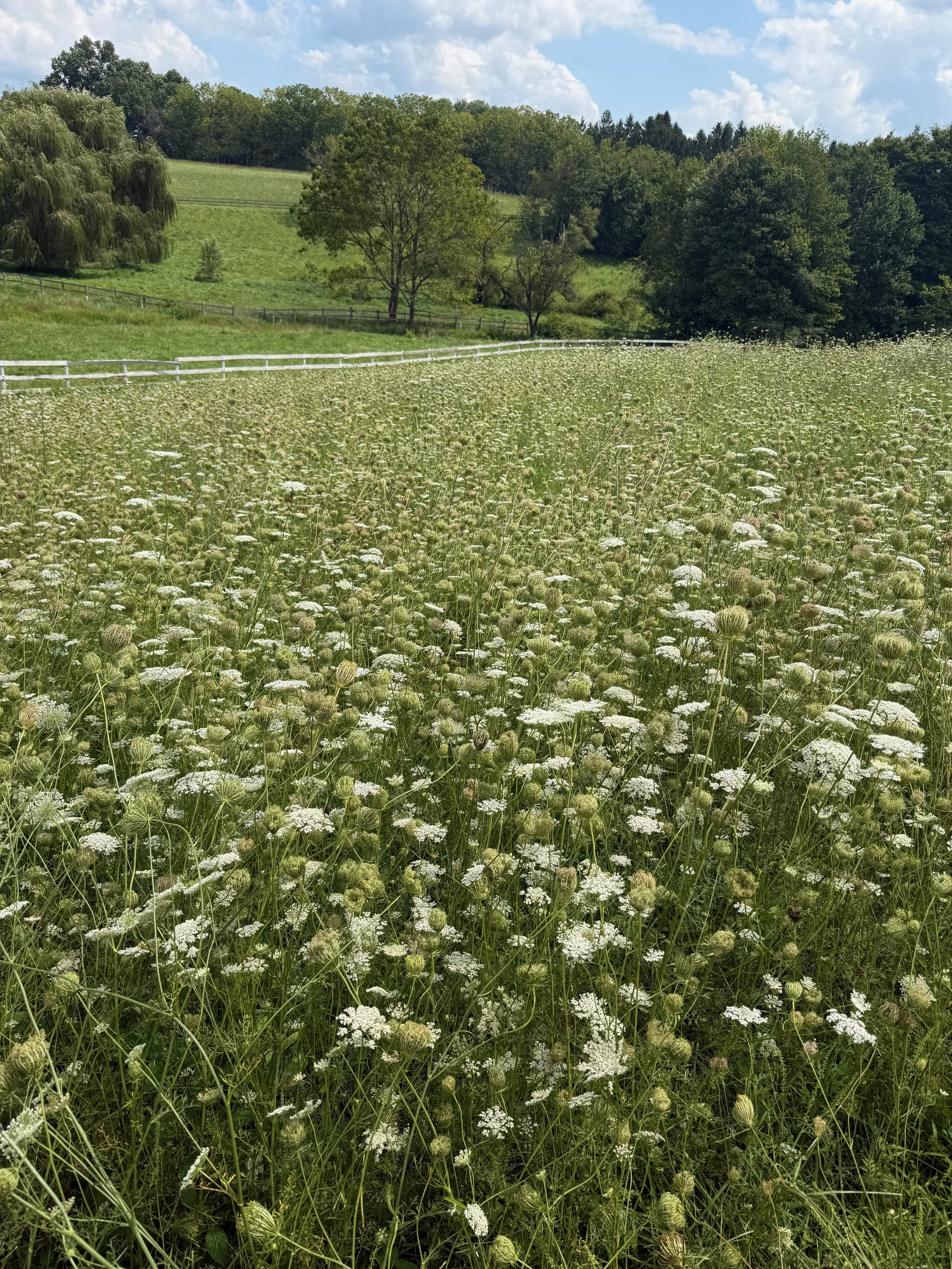
Wild Carrots in the pasture
Fiber and Shop
I had been making various posts on social media to show how a fleece was processed (from Cutie Pie, our star goat) from start to finish, and completed that series in early August by posting on the last step - making yarn from the roving. In this case I made a normal 2-ply mohair yarn from her fleece — that turned out very well. I just used a small part of the fleece and the rest of it will either go to a mill to be spun into yarn or made into roving - or I will make batts with it here and maybe spin some more yarn from the batts; I have not yet decided.
Mid month I made a novel yarn by connecting together remnants of various hand spun yarns into a skein, adding twist to the skein, and then spiral plying this skein onto a core to make a new yarn - with lots of color and texture. (And posted on this 16 August.) A very interesting process; I had read about it in the Spin Off magazine and wanted to try it. It certainly can make a unique yarn and does use up remnants of yarns left over. One of the advantages of hand spinning is the interesting and novel yarn creations you can make.
Another interesting project (that again I posted on) was to fix a few gaps that had developed in a felted vessel/bowl. Depending on the felted item, quite often if something happens to the item, you can repair it. The trick was trying to blend in what I did so it would look natural and not like an obvious repair. I somewhat succeeded. The texture around my felted repair is a bit different than the original felted appearance, but I had to fix a few spots and one could imagine that these somewhat different areas of texture and color were put there deliberately. Kintsugi is the Japanese concept of repairing broken pottery with lacquer dusted or mixed with powdered gold, silver, or platinum. Instead of hiding the cracks, this philosophy treats the breakage and repair as a beautiful part of the object's history, embracing the imperfections rather than disguising them. So, perhaps I could say that I was following this concept - although applied to felting, not pottery.
And of course there were many other things happening in the shop with other handspun yarns being made, yarns dyed, batts made on the drum carder etc.
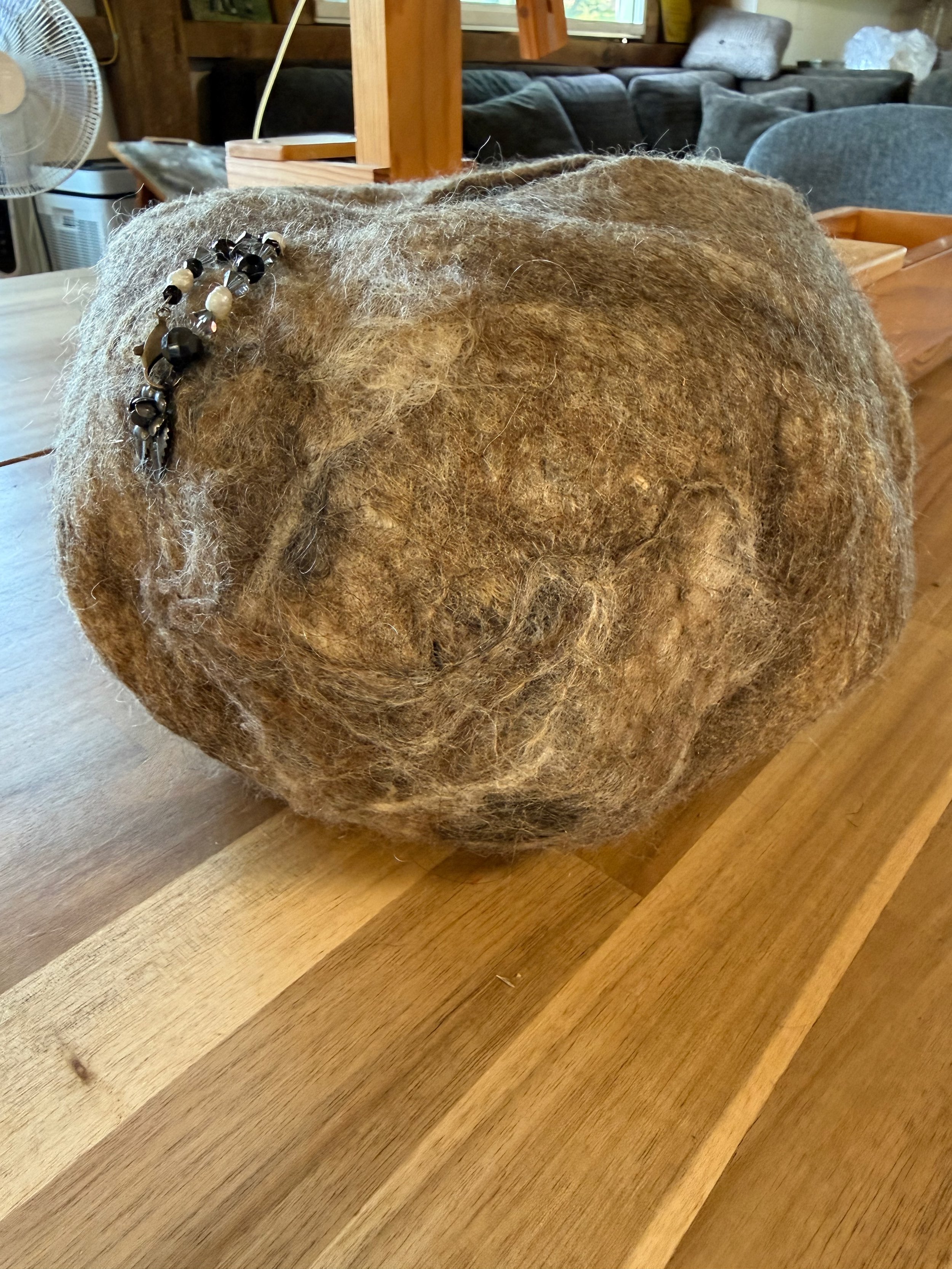
The felted bowl/vessel that was repaired
Events
Various classes continued at Withers Wool and Farm in August: Painting with Wool, Fiber Processing and Drop Spindle. (I posted on the drop spindle class on social media on 11 August, and wow did that post get a lot of views and likes.)
The next external show Withers Wool and Farm will be at is the Shenandoah Valley Fiber Festival (SVFF) which takes place in Berryville, VA 26-27 September. As in past years, Withers Wool and Farm will be in the Ruritan building. The show is open Saturday 10-5 and Sunday 10-4.
And on Saturday, 12 September, we will have a needle felting class at the farm from 11 to 2 to make a cute lamb. If interested, sign up using the form at the bottom of the Classes and Workshops page at www.witherswool.com
I hope to see you at the shop or at the Shenandoah Valley Fiber Festival.
#######################################################
Instagram: withers.wool; Facebook: Withers Wool and Farm