
Baby Goat Planning
A lot of planning goes into figuring out the birthing of the baby goats. The two main factors are the timeframe/date you want to have the briths and the number of baby goats you want to (try to) get. Following from that then is the number of does to breed and the buck (or bucks) you will utilize. This year I put a buck in with 5 does; I ended up with two does that got pregnant and had babies. I will go through these factors to describe what I was thinking, why only two got pregnant, and what I plan to do next year.
First the timeframe. A doe has a gestation period of 5 months/150 days. The Angora does go into estrus starting normally around September and going as late as February/March - although they are more active in the fall and these are approximate timeframes. In goats, the estrous cycle averages 21 days, with the actual estrus (heat) lasting roughly 36 hours, although it can vary from about 12 to 48 hours depending on the age, season and the presence of the buck. Second factor is the number of kid goats (babies) desired. Angora does normally deliver a single or twins (and very rarely triplets). My rule of thumb is about a third of the does will have twins, but this can vary considerably year to year.
Given my personal schedule, this year I took actions to try to have babies born between late May to early July. Accordingly, I put a buck in with the 5 does on 24 December, figuring I would probably get 5 to 7 kids. A complication arose in that the buck got sick after 5 days with the does and I had to pull him out. (I did figure out his issues and he recovered - but I did not want to put him back in with the does as breeding can stress their system.) So I put a second buck in with the does on 5 January. I then took the buck away from the does on 9 February. So my window for the does to have babies was from 24 May to 9 July. (Give or take a day or two on each end.) The end result was that Peaches had twins, a buck (Squall) and a doe (Windsong), on 24 May; and Tulip also had twins, two bucks (Balmy and Zephyr), on 4 June. None of the other three does had babies.
It can be tough to tell if a doe is actually pregnant. There are various indicators: their udders can get larger, the ligaments around their hips can get softer, and they can have a nesting behavior - all possible signs very close to giving birth; and during the pregnancy, their sides can become rounder and their belly may hang lower. The signs close to giving birth are usually reliable (especially the udders and hips), but the more general signs (rounder sides and hanging belly) are not as reliable - or noticeable in many goats. I know the bucks were both fertile, as based on the timing Peaches got pregnant from the first buck and Tulip got pregnant from the second buck. And of the three who did not get pregnant, one had a baby the prior year, so I know she previously was fertile. What I think happened with the three does that did not become pregnant was they stopped their estrus cycle when I put the second buck in. Although they can be in estrus thru March, it is more reliable in the fall and early winter.
Anyway, the current set of babies are all doing well and having less kid goats does cut down on the work. My plan right now for breeding the goats this coming year is to put together a buck with whatever does I want to try to breed from mid-October to mid-November. Assuming the does get pregnant, they would have their babies sometime between mid-March and mid-April. The considerations for this are: (1) do the breeding earlier so the does do not go out of estrus; (2) this is a timeframe when I have no shows - and can be on the farm - as you want to be available when a doe has her baby/babies so you can provide assistance as needed. Normally the Angora does have their baby/babies without any assistance, but sometimes you need to help dry the baby off or if it is chilled, warm it up. And about half of the time you need to gently assist the baby to nurse.
One other consideration, and one reason this year I shifted to a later birth cycle, is my shearing cycle. I shear the goats in mid-May and again in mid-November. The main reason for this is the mid-May shearing; you want the goats to have less fleece as they go thru the hot summer months. Baby goats born in May/June are fairly well aligned with the normal shearing cycle, but baby goats born in March/April will be somewhat off that cycle. Accordingly, I’m thinking that I would shear them earlier than the adults, say late October or early November. (If their fiber gets too long, for later processing this can be an issue if you want to blend with fiber that is not as long.)
That’s pretty much it. I hope you enjoyed reading this and now have an appreciation for the factors - regarding timing and numbers - that go into breeding the Angora goats. Other considerations are the genetics and traits you are looking to enhance regarding breeding - but I will save that discussion for another time.
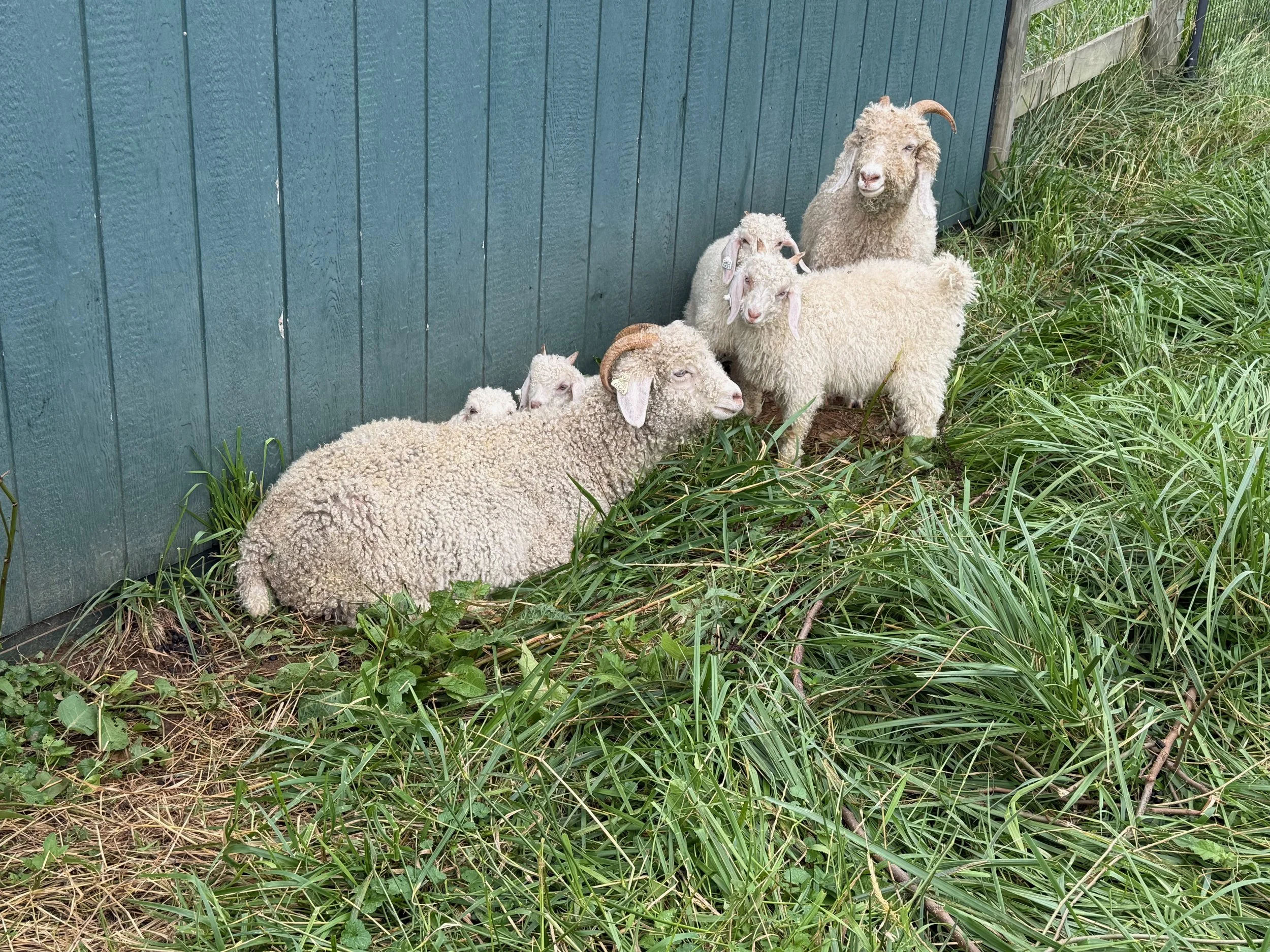
Angora does and their kids from 2025