
July 2025 Happenings at Withers Wool and Farm
Farm and Animals
Only two Angora does ended up having babies: Tulip and Peaches. Both had twins. The other three does that were in with the buck did not get pregnant; so this year just the 4 kids. (In the next mid-month newsletter, I am going to discuss in detail the planning and considerations for having baby goats and what exactly I think happened this year.) The babies are all doing well, growing and gaining weight as expected, and a joy to watch. They love having people visit them - and then getting to nibble on tortilla chips as a snack. They are actively grazing and still nursing from their mom. I am no longer regulating how much time the moms and babies stay on the fields. I open the gate to let them out mid-morning, once the pasture is relatively dry, and they graze as they see fit. Usually they will graze an hour or so first thing, take a break late morning, go out again early afternoon and then stay off the pasture and lay near the fans for a few hours (especially on the hot days) and not go out to graze again until late afternoon.
I’ve discussed dealing with the hot and humid summer weather before - so no more of that. According to my weather app, we have a few more real hot days to come through the end of the month and then much cooler weather for a while. (I hope that is correct.) Even though it has been hot in July, there has been lots of rain (at least at Withers Wool and Farm) and the pastures are lush and green and great eating for the goats and sheep.
One new issue that has come up with the Angora goats - but not the Merino sheep - is ticks. Prior to this year I had never seen a tick on a goat and since I shear the goats myself, I would know. However, this year during shearing in May, I found a number of ticks (I think the American dog tick) on one of the Angora bucks. I check the goats (and sheep) in summer every two weeks for general health and body condition and a month ago I found a tick on about half of the goats. I do treat the sheep and goats with a pour on insecticide (the commercial name is Ultra Boss). Previously, I was using this on them once a quarter. Doing some research, I read it can, and should, be applied once per month if you are having tick issues, so I am now following that guidance. It appears this is working; I will continue to check the animals every two weeks and assess the situation.
The birds (chickens and peafowl) are all fine. The peahens are still laying their eggs, which I pick up as I do not want any new peachicks. The peacocks have started to lose a few feathers; towards the end of August their long tail-feathers will really start to fall out; I will pick up the good looking feathers to put in the vases in the barn/shop.
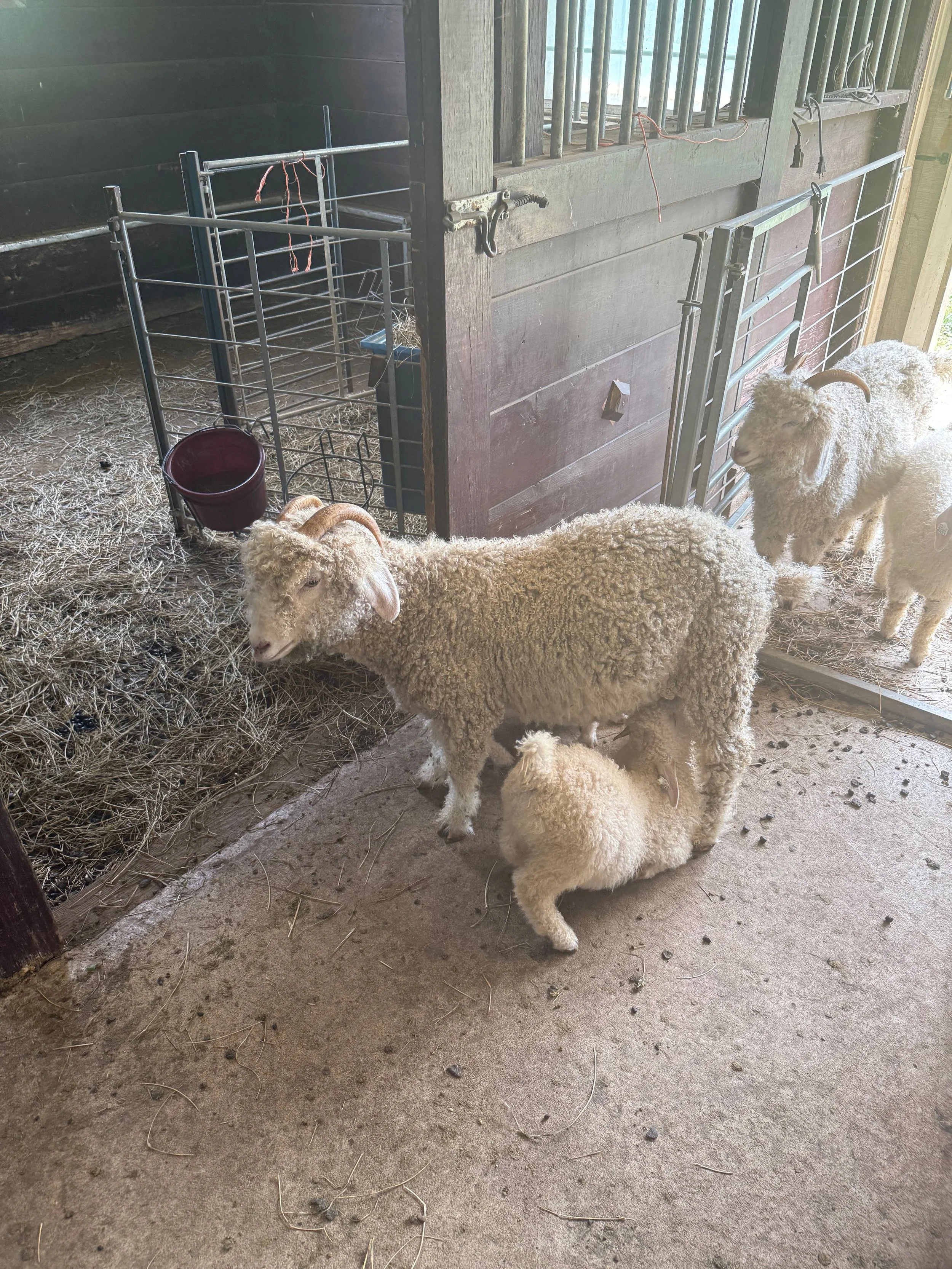
Tulip nursing her twins
Fiber and Shop
A big new project in the shop in July has been Nuno-felting - and that was the subject of the July mid-month blog. We made a number of Nuno-felted shawls and scarfs, which are now available for sale in the shop. Two Nuno-felting classes have been scheduled; more info on that in the Events section.
Then, after Nuno-felting, we moved on to doing a lot of dying - of skeins of yarn. The intent has been to be able to regularly and purposefully recreate various color variations. Overall we have been successful and the experimentation continues. I will discuss this in more detail in a future newsletter and/or blog. As a teaser, both the amount of dye you utilize as well as the “shape” of the yarn in the pot can influence how the yarn absorbs the dye.
Given the time spent on Nuno-felting and dying, as well as taking care of visitors to the shop (lots of people came by in July), there has been less time spent on hand-spinning. What time I did allocate to spinning has been used to make a few crepe yarns and stand-alone singles. Stand-alone singles can be a challenge as you have to add enough twist to create a coherent yarn but not so much that your yarn does not balance after finishing. And, of course, every little variation in the single stands out so one needs to spin very consistently to have the single look good and not show too much variation. If you have tried to spin stand-alone singles and not gotten the results you want, you are welcome to talk to me about that and bring your spinning wheel to Withers Wool and Farm and work on a stand-along single. (And as with Tour de Fleece, you can grab an ounce or so of roving, gratis, to use.)
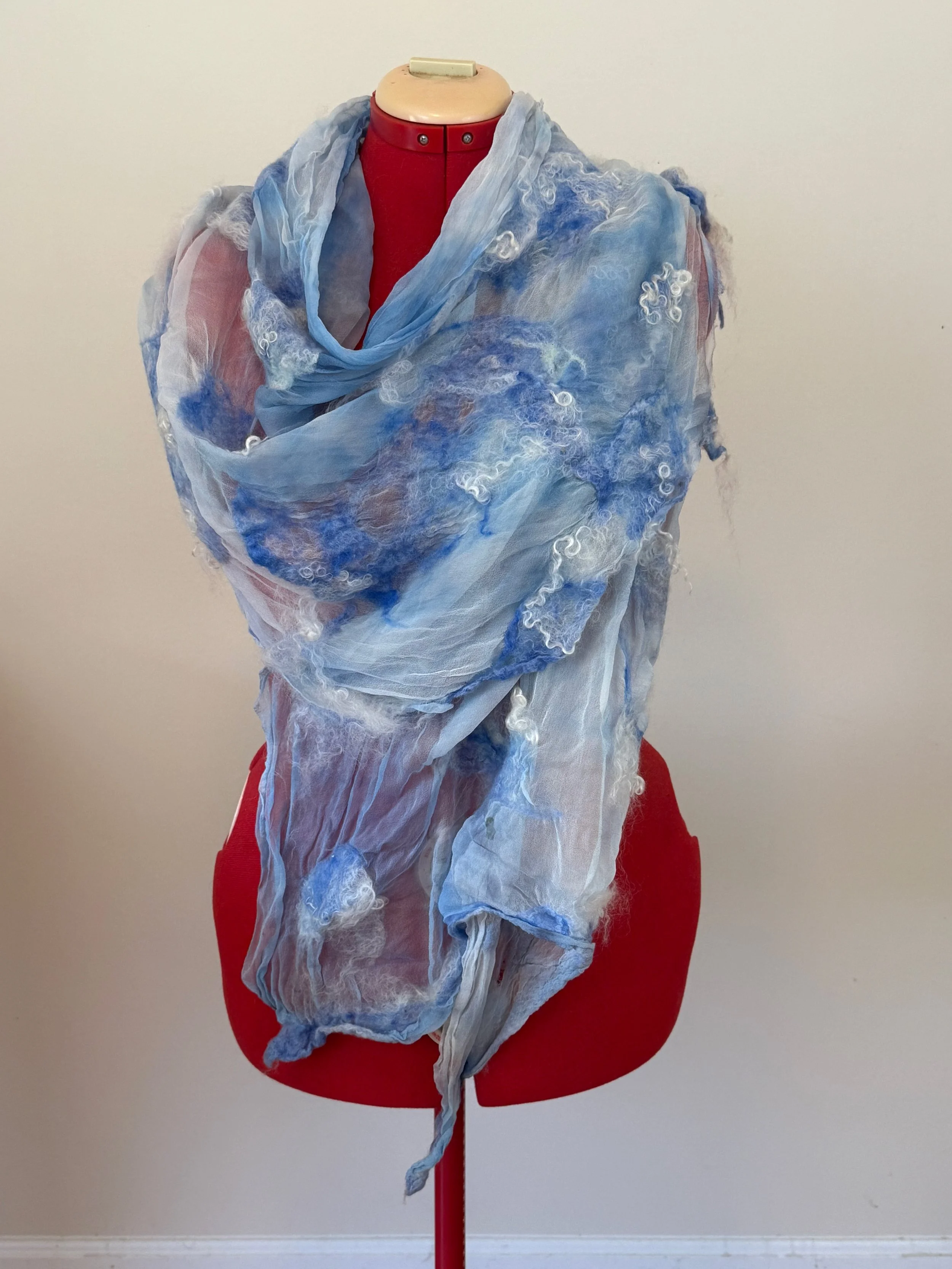
Nuno-felted shawl
Events
Tour de Fleece has come and gone, starting on 5 July and finishing on 27 July. A number of people did stop by to spin at Withers Wool and Farm (and other FAST locations) and a good time was had by all. If you did finish a row on the FAST bingo card (or finish the entire card), do let us know so you can get your prize(s). A number of folks posted about their Tour de Fleece spinning and it was interesting to read how they progressed.
I have scheduled two Nuno-felting classes: one on Saturday 9 August and one on Sunday 17 August. You can sign up by filling out the form on the Classes and Workshops tab: Click Here (As with all classes and workshops, if you want to take a class/workshop and a scheduled date/time is not possible for you, reach out to me to coordinate a mutually agreeable date/time for you and/or your group.