
Using a Drop Spindle to Spin Yarn
I just taught a Beginning Drop Spindle class and thought I would write a short blog about the drop spindle, what it is, how you can use it to spin yarn, and some differences between the drop spindle and a spinning wheel. I will do this by posing a series of questions and then answering them; somewhat of a FAQ regarding the drop spindle.
Q: What is a drop spindle? A: A drop spindle is a simple, portable tool that can be used to spin roving, batts, etc. into yarn by twisting them together; it consists of a shaft, a weight (whorl), and a hook, that is spun and allowed to dangle freely, creating yarn that's wound onto the shaft as it forms.
Q: What are the different types of drop spindles? A: Drop spindles come in various designs, each with its own spinning capabilities and unique features. The three different types of drop spindles are bottom whorl, top whorl, and Turkish spindles. Bottom whorl drop spindles have the weight (whorl) at the bottom, while top whorl drop spindles have the weight at the top. Turkish spindles have a middle crossbar with arms extending from the centre.
Q: What is the most common type of drop spindle? A: Top whorl drop spindles are generally considered the most common and popular type in the USA, especially for beginners, due to their ease of use, lighter weight for faster spins, and suitability for creating fine yarns, though bottom whorl spindles are also used for thicker yarns and historically significant. Most drop spindles sold today in the USA are the top whorl designs.
Q: What are the advantages of a drop spindle? A: (1) low cost and accessibility; they are inexpensive entry points into spinning, allowing experimentation before investing in a spinning wheel (2) portability; their small size means you can spin virtually anywhere (3) ease of learning; simple design (shaft, hook, whorl) and slower pace help beginners grasp core concepts such as drafting and twist building (4) control and versatility; provides spinners with control over yarn thickness and texture, allowing for experimentation with different weights and ply.
Q: What are the disadvantages of a drop spindle? A: The disadvantages of a drop spindle primarily involve a steeper learning curve, requiring practice for consistent rhythm, managing its tendency to backspin or stall, needing more space for its free-hanging spin, and potential for uneven yarn due to wobbling or improper drafting, especially with lightweight spindles or difficult fibers.
Q: So how does a drop spindle compare to a spinning wheel? A: Comparing a drop spindle to a spinning wheel involves weighing speed and production against portability and cost..
Key Comparison Points
Production Speed: Spinning wheels are significantly faster for producing large quantities of yarn. While a wheel allows for continuous spinning, a drop spindle requires most spinners to stop frequently to draft the fiber and then wind the newly made yarn onto the shaft manually. (A few spinners can achieve continuous drop spindle spinning - often called suspended spinning.)
Portability: Drop spindles are the ultimate portable tool, fitting easily into a small bag for spinning while walking, traveling, or waiting in line. Spinning wheels are floor-based and generally more difficult to transport. (There are a few very small portable spinning wheels.)
Cost: Spindles have a very low point of entry, whereas new spinning wheels can be a major investment. (Although used spinning wheels can often be found at a reasonable price.).
Ease of Learning: Drop spindles allow beginners to learn the basic physics of "twist and draft" without having to coordinate foot movements. Whereas spinning wheels require coordinating hands and feet (treadling) simultaneously.
Physical Comfort: Some users find wheels easier on the body as they allow for a seated position and utilize foot power rather than constant arm movement, which can be tiring with a spindle.
Q: What is the “Park and Draft” method? A: This is the recommended method for beginners to utilize the drop spindle. You spin the spindle to build up twist, then "park" it (pinch it between your knees or under your arm) so you can use both hands to draft the fiber without the spindle falling.
Q: Can I ply my yarn with a drop spindle? A: Yes, you can ply with a drop spindle. A common method of plying your yarn with a drop spindle is to wind your single strand of yarn into a center pull ball using a ball winder or nostepinne, then ply the inside and outside ends together.
That is enough! What I generally tell people when they ask me about using a drop spindle is that the “good” news is that you have total control over what your are doing, and the “bad” news is that you have total control over what you are doing.
Withers Wool and Farm does offer a Beginning Drop Spindle class if you want a jump start on using a drop spindle. (Go to the Classes and Workshops page at www.witherswool.com) For more info, there are many good books and videos. A classic book is Respect the Spindle by Abby Franquemont. A popular video is “Drop Spindle Tutorial for Beginners” by Jillian Eve (on YouTube).
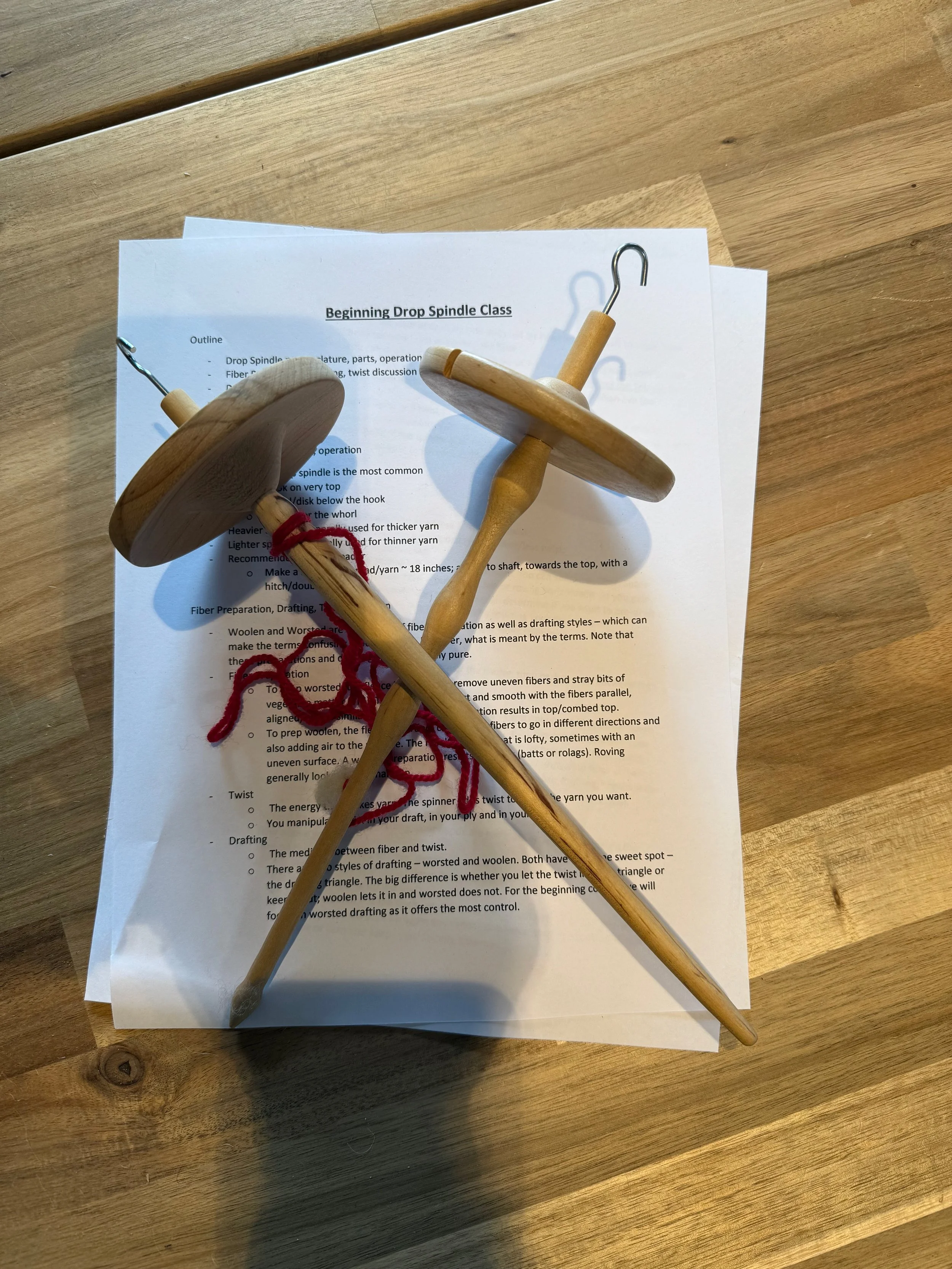
Picture of drop spindles and class notes