
April 2026 Happenings at Withers Wool and Farm
Farm and Animals
Greeting spinners, knitters, crocheters, felters, fiber enthusiasts, artists and animal lovers: here is the April 2026 newsletter from Withers Wool and Farm.
I would assess that we have had very typical April weather this year with the temperatures veering all over: some warm days, some very cool days (with a freeze thrown it) with frequent showers and thunderstorms. The grass is exploding and buds and blossoms are popping up across the landscape. If you are a gardener, you have probably been busy in you various beds.
The biggest news from an animal perspective was the birth of two baby goats. I talked about this extensively in the mid-month newsletter so will only briefly discuss that here. A baby doe was born to Plum on 4 August and a baby buck was born to Lily on 7 August. (A third doe, Strawberry, was bred, but did not get pregnant.) Both babies are doing well and having a great time playing with each other and exploring. They were put together on 11 April and first went out on pasture on 16 April. The babies will continue to nurse from their mothers but have started nibbling on grass and hay. If you follow me on social media you know I reached out for suggestions for their names - with a tree theme. (Every year we have a new theme for names - past themes have been flowers fruit, spices and weather). Willow for the doe and Ash for the buck were the highest count so I went with that.
Lots of spring clean up. The material from the two large compost bens (from cleaning the goat and sheep pens and the chicken and peafowl areas) was emptied. In the orchard (to the left as you enter Withers Wool and Farm), we have started a permaculture bed. A permaculture bed is a sustainable, raised garden mound built by layering rotting wood, branches, leaves, and compost. These beds mimic natural forest decomposition to create self-watering, nutrient-rich soil that requires minimal fertilizer, reduces watering needs, and acts as a "sponge" to retain moisture. One interesting addition: our mound included wool and mohair that I cannot use in the shop. We plan to use this bed to raise asparagus. (BTW, Withers Wool and Farm has both wool pellets and bags of wool/mohair that you can purchase to use for mulch, compost, etc. The pellets I have made at a mill and the bags are wool/mohair gleaned from when I skirt the fiber and also the belly and leg fiber from shearing the sheep and goats.) Also, the pollinator garden was cleaned out and new mulch put down.
One thing I have to watch out for is mushy/clumpy stool in the sheep or goats. This is a normal reaction to the high-moisture, high-protein, and low-fiber lush grass and can cause rapid digestion - with the accompanying soft stool. While some minor loosening is common, it firms up as their systems adjust. To manage, you keep them on dry hay (e.g. at night), and limit grazing time initially. Also, I bring the sheep and goats in when it rains and they do not go back out on the pasture until it is dry. One goat, Strawberry - the goat who did not get pregnant, ended up with some mild diaharea and I had to treat her with pesto bismal to get her system back in order.
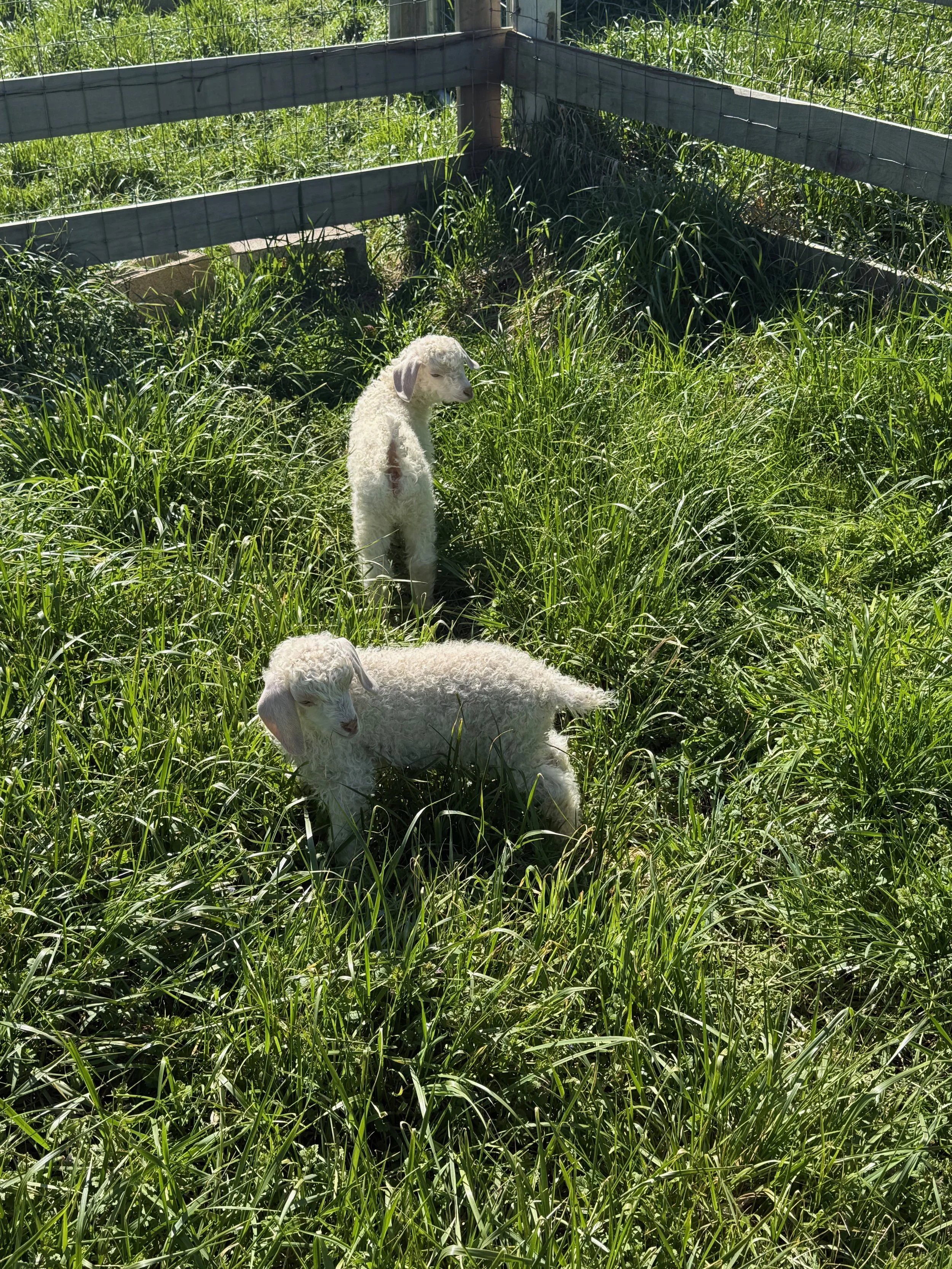
The two baby Angora goats - Willow and Ash
Fiber and Shop
I reorganized how the various mill spun yarn was positioned in the shop. The old display simply evolved - as new mill spun yarns were received from the mill, they were put on the shop floor. And so there was an intermixing of yarn weight and colors. Now (mostly), you can find each of the yarn weights together (generally sorted by color): fingering, sport, DK and worsted. The sock yarn and the yarn that has linen and ramie in it (and some marled yarn) are still set aside in a different area. We have 50 lots of different mill spun yarns, along with over 300 skeins of separately dyed mill spun. The goal with the separately dyed skeins is to have different and unique color combinations achieved via the various dying techniques. (And a number of yarns have been dyed this month.)
On 13 April the six Merino sheep were sheared. No issues. Each fleece weighs about 15 pounds. I did my initial skirting of all the fleeces (a few minutes with each fleece to remove any large pieces of vegetable matter and sheep poop as well as any very damp patches) and then bagged them up to be processed later. One fleece that was slightly damp I went ahead and fully cleaned (more extensive skirting, washing and rinsing, and finally tumbling) as putting a damp Merino fleece in a a bag invites felting.
There were lots of new hand spun yarns produced for the shop: singles, 2 ply, thick and thin, and yarns with core spun locks that were then spiral ply’ed for a very unique look. All in time for the Maryland Sheep and Wool Festival (MDSW) - see below.
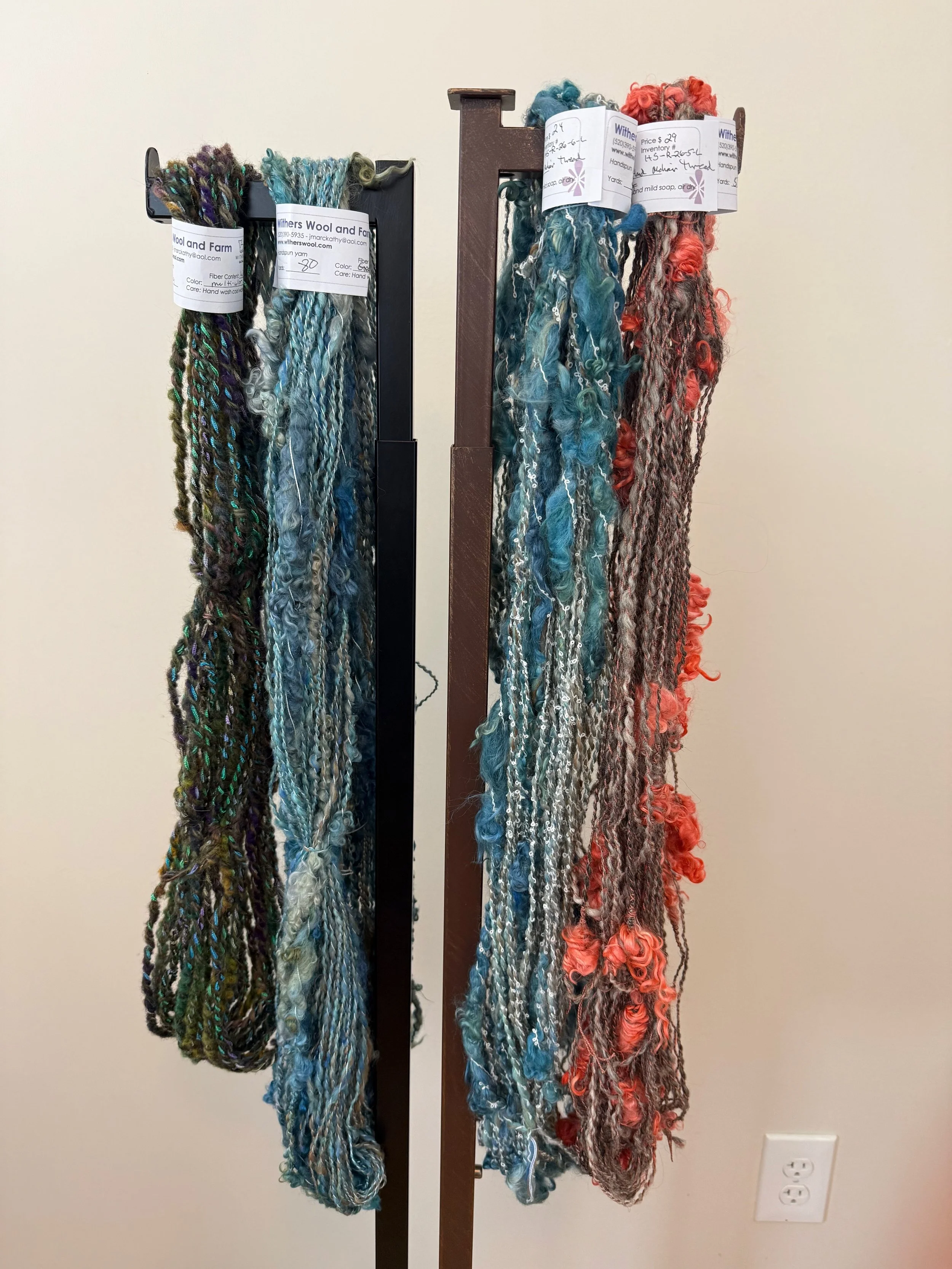
Some of the new art yarns
Events
We continued the pace with a variety of classes and workshops in April: carding, beginning spinning and 3 D needle felting (to make an owl). On 23 May there will be a needle felting class to make a Highland Cow.
And once again the Maryland Sheep and Wool Festival (MDSW) is here. This is the 53rd annual festival; as normal, it is the first week of May, so 2-3 May this year, at The Howard County Fair Grounds. The festival includes over 250 vendors, 600+ sheep, 40+ workshops, "Sheep to Shawl" competitions, and agricultural seminars. Tickets are available online ($12.50 + fees) or at the gate ($15.00), with free admission for those under 18. As in past years, Withers Wool and Farm will be in the Main Exhibition Hall, booth B06 (as you enter the Main hall, go the left and look for us on the right, up 6 booths from the entrance). The festival is open 8:30 to 5:00 both days. Withers Wool and Farm will be closed on Friday 1 May, to set up, and Saturday, 2 May, while at the show.