
March 2026 Happenings at Withers Wool and Farm
Farm and Animals
Hooray, spring is here! We are still having some brisk chilly days occasionally but winter is over. The grass is starting to grow, buds are coming out, I see bird nests being built, there are some new leaves on the trees, geese are at the pond, and colors are emerging on the foliage. What a long cold winter we had - at least for Maryland. Great to be past that.
I mentioned last month that I had bred three does in the fall. The window for them having a baby is from 18 March to 22 April. On 15 March I separated them from the rest of the does so they can get extra grain and also so I can more easily periodically check on them. They are now in the field around the white barn. (The other does are in the fields around the red barn/shop.) At night, they go into a pen that has cameras and a baby monitor. Two show signs of being pregnant - but it can be hard to tell with Angora goats. There have been times in the past when a goat that was bred did not look pregnant and had a baby and vice versa; a goat that we thought was pregnant did not have a baby. There are some tests that have come out in the past few years that can detect pregnancy that are supposedly reliable and I think in future years I will try them. For now I am watching the 3 does and waiting.
The peacock has fully grown his tail feathers, has his full plumage, and is courting the peahens. The full sequence of actions he goes through is very impressive: he raises his long, iridescent train feathers into a massive fan and shakes them to create a mesmerizing shimmering effect and a fluttering sound. He frequently turns to keep his fan facing the peahen, often positioning himself to optimize sunlight on the feathers. This series of actions can last for 2-3 minutes.
I had some more brush and brambles cleaned out of another field and then again threw out a forage mix (composed of fescue, chicory, alfalfa, red clover, birdsfoot trefoil, orchard grass, and peas) to try to get a more bountiful and nutritious growth of vegetation for the sheep and goats.
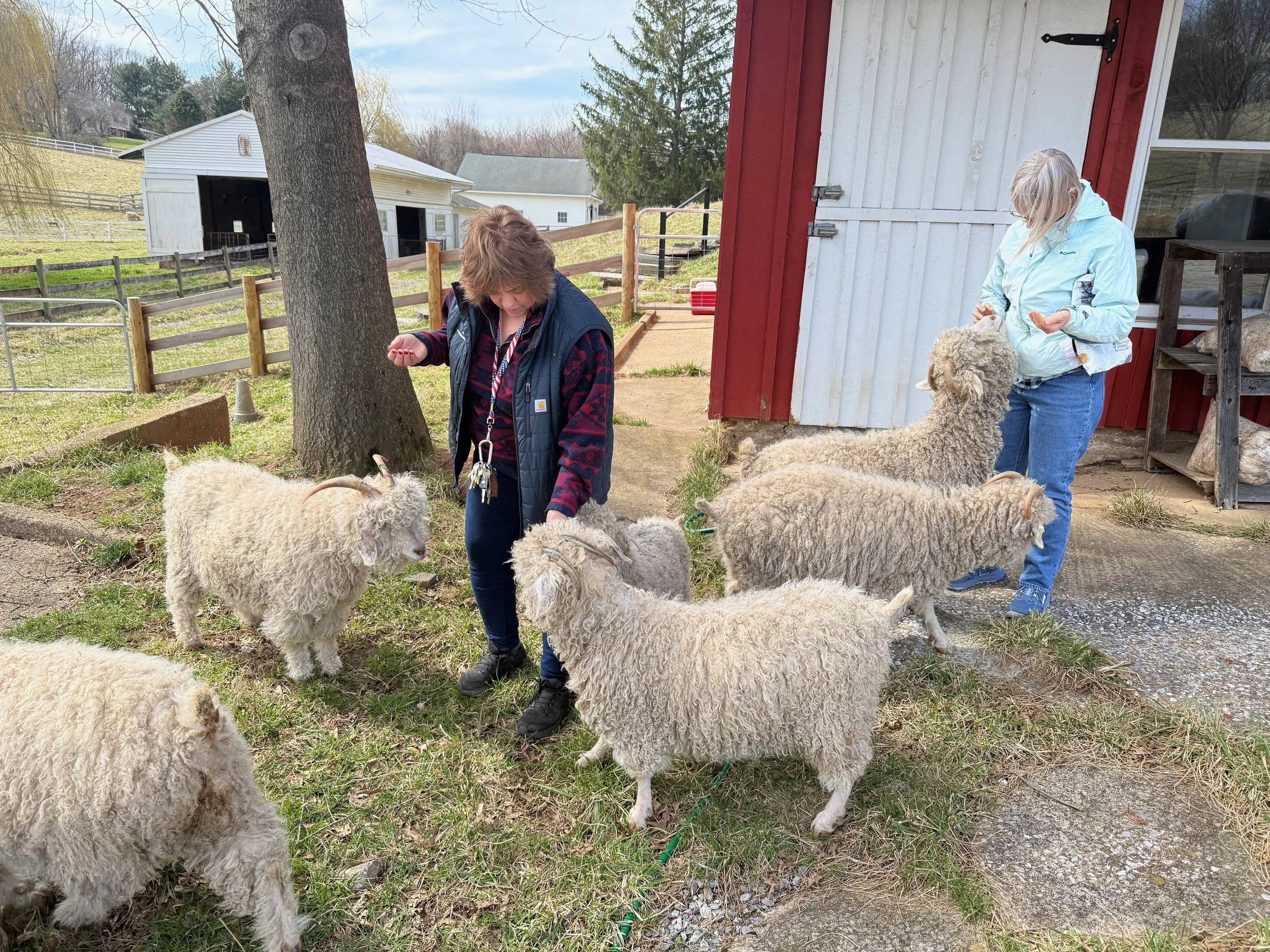
Angora goats enjoying some treats and the nicer weather
Fiber and Shop
Normal activities in the shop in March: spinning, carding, felting, some reorganization, and (lots of) classes. Regarding spinning, on 20 March I did a post about spinning a yarn from a batt (versus roving). Spinning from a batt offers artistic flexibility, allowing for complex color blending, varied texture, and (depending how the batt was made), perhaps a loftier, "woolen" style yarn compared to the uniform, combed nature of roving. I think the main advantages are the ability to do custom blending and achieve unique color management. Batts made on a drum carder allow spinners to mix different colors, fiber types, and textures (e.g., nepps, sparkles) that cannot be achieved with pre-prepared roving. And batts are excellent for creating gradual color changes or blending distinct colors together, offering more control over the final gradient or variegated look.
I have (slowly) started to reorganize the placement of the mill spun yarn in the shop. Currently the mill spun skein placement just evolved; as I have received more mill spun yarn, I just put it in an available cubbyhole/space. My observation is that people are searching for both gauge and color. And so, to provide a bit more sanity to the placement of the mill spun, for the solid colors, they will be organized by gauge (e.g. all fingering together, all sport together) and within the gauge, (generally) sorted by color. The hand-dyed mill spun yarn with mixed colors will continue to be a more varied placement, semi-organized by color. (It is hard to organize these yarns by color when many have multiple colors.) Hopefully this will help when one is looking for a specific yarn within a predetermined gauge. (Not sure how long this will take me - hopefully all done by the end of April.)
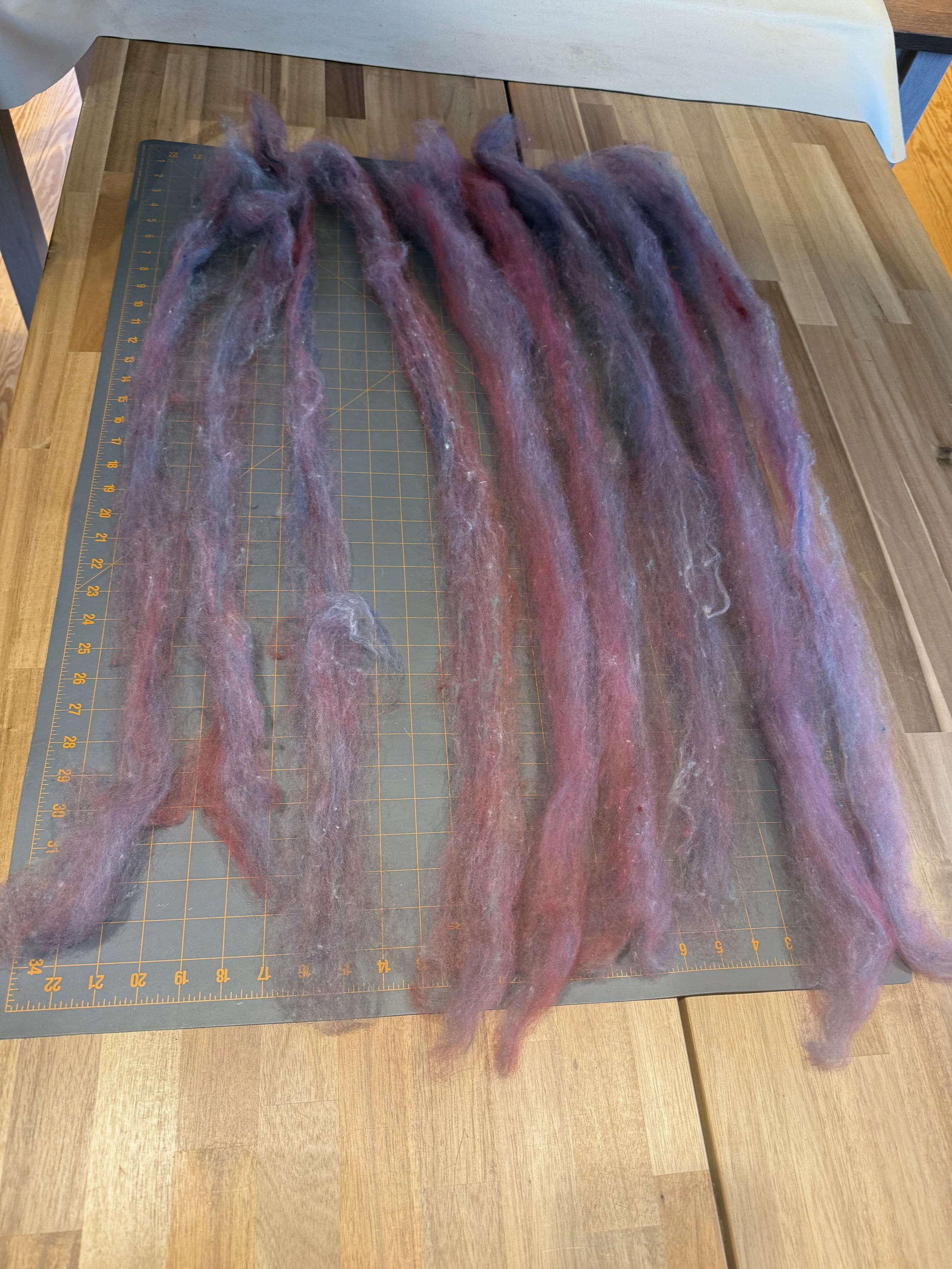
Strips from a batt to be spun
Events
Lots of classes/workshops in March: 2 nuno-felting classes; 2 painting with wool workshops; 2 beginning knitting classes; 3 beginning spinning classes; and 1 3D needle felting class (to make an alpaca). Except for the needle felting class to make an alpaca, all other classes were set up by people reaching out (via the form on the Classes and Workshops page at www.witherswool.com). The next 3D needle felting class is scheduled for 18 April - to make a picturesque felted owl.
And get ready, the 53rd annual Maryland Sheep and Wool Festival (MDSW) is coming up: on 2-3 May at the Howard County Fairgrounds. As in past years, Withers Wool and Farm will be in the Main Exhibition Hall, booth B06 (as you enter the Main hall, go the left and look for us on the right, up 6 booths from the entrance).